
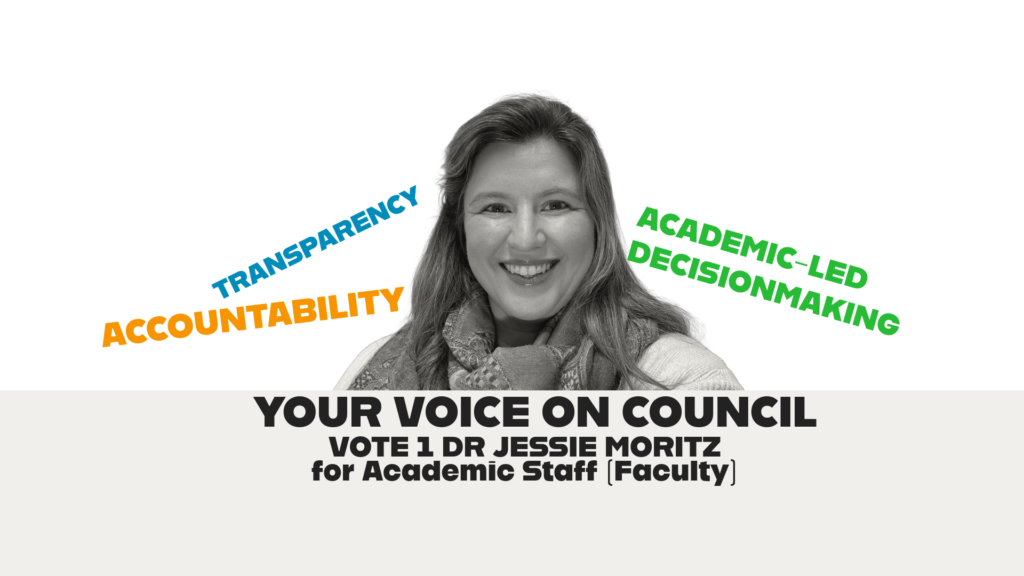
I’m Dr Jessie Moritz.
I designed and led the ANU Governance Project – which brought together over 600 ANU staff, students, and community stakeholders to improve our university from the ground up.
I have a plan to create a different kind of ANU Council – one that brings your voice more into Council decisionmaking.
I’m running to be your next Academic Staff (Faculties) member on Council and I need your support.
You – academic staff – have the knowledge to fix our university. I’ve been working for over a year to bring your ideas together and get them implemented.
Every issue – accountability, transparency, change management – improves when YOU, our academics, have greater power in decisionmaking.
VOTE NOW
Voting online for the election is now open and will close at 5pm (AEST) on Friday 4 September 2026.
To cast your vote please use the following web link to the ANU Apollo Poll: https://apollo.anu.edu.au/default.asp?pid=24844
Only members of the academic staff employed in a full-time or part-time standard or fixed term capacity, who are of or above the grade of academic level A, and who were paid a salary on payday 16 July 2026, are eligible to vote in this ballot.
Why I should be your #1 vote for Academic Staff (Faculties) representative
- I’ve got a track record of bringing faculty voice into decision-making. I designed and led the ANU Governance Project – a community-led project involving over 600 ANU staff, students & community stakeholders to improve our university from the bottom-up. I designed the project, led the team of 30+ staff and students to deliver it, led the analysis and write-up of both the draft and final reports, spoke at Senate to explain our findings, and have been staunchly advocating at every level for adoption of the reforms the ANU community said they wanted to see.
- I know what reforms are possible because I’ve done the groundwork to make them happen. I’ve spent the last six months meeting with university decision-makers – from research school directors up to ANU Executive & Council members, Senators and MPs, regulators & the Department of Education – to build consensus on reforming ANU in line with community expectations. ANU Council is where most changes will ultimately succeed for fail – I want to be there to ensure we produce real change for our university.
- I have a plan to bring YOUR voice onto Council.
- ANU Council needs policy reform but also a cultural reboot; the changeover of elected and appointed members creates an opportunity for this to occur. My goal is to build a regular culture and practice of engagement with faculty.
- If elected, I’ll run regular ‘Council coffee’ meetups at The Coffee Lab or a similar venue on campus. I’ll share the issues that are shaping my activities on Council (without breaking confidentiality), and listen to your views on what would best help you continue to produce world-class research & education.
- There is already appetite among current Council members to engage in listening sessions with ANU staff & students, but it hasn’t made it to the top of the to-do list. I’ll bring the energy to organise the sessions – and invite them to join me.
- There’s no burden on you to participate, but it’ll be there when you most need it. You can also submit your views on any issue through my website, email me, or just drop by my office.
- I’ll work to bring your voice in through other mechanisms too – such as pushing for faculty reference groups, regular participation of Council members at ANU Townhalls, and the policy changes outlined in the ANU Governance Project’s final report that will help to empower our academic community to hold the Executive and Council accountable.
What policies and practices will I advocate for on Council?
- Faculty input on critical decisions that affect our work, including casualisation, teaching and administrative workloads, access to research funding and support services, etc.
- Increased accountability of ANU Executive and Council to faculty by strengthening academic board and establishing a university senate.
- Transparent senior appointment selection processes (like the next Chancellor and Vice-Chancellor!)
- Financial transparency. Faculty should have access to sufficient financial information to be able to evaluate the impact of change management. Other universities do it as a matter of routine – we can too.
- Academic freedom and institutional integrity. Faculty should determine the content and format of their research and teaching, not administrators or external politics.
- All the reforms that have already emerged from the ANU community through the ANU Governance Project. I will advocate staunchly for the reforms put forward by over 600 members of our community through the ANU Governance Project, which you can read in detail on the ANU Governance Project website.
These reforms might not have seemed possible 12 or 24 months ago – some may now be required by federal legislation and the TEQSA/Briggs Review. How they are implemented matters. I have the detailed knowledge of higher education governance and the changes already underway at ANU needed to ensure that Council’s commitments are meaningful and will deliver real change for staff at the ground level.
Our sector remains under pressure. My goal will be to work through Council to help reshape internal governance so that the next time we face a crisis, ANU’s faculty are positioned to work transparently with ANU leadership in determining the response to that crisis and holding them accountable for its delivery. That’s how we prevent a repeat of RenewANU.
Who am I?
I’m a Senior Lecturer in the Centre for Arab & Islamic Studies at the Research School of Social Sciences. Normally, I research authoritarian governance and how citizens create reforms where there are no elections or formal mechanisms for popular participation. It’s surprisingly applicable to university governance!
Part of my work focuses on how billion-dollar economic development programs translate into incentives for citizens on the ground level. Put simply: the goals leaders have at the top can result in very different – even perverse – outcomes at the bottom once they filter through each layer of bureaucracy. It’s a basic principle of good governance – whether of a state, a corporation, or a university – to have effective mechanisms for upwards information flow about how decisions are playing out on the ground. At the ANU, we need better systems to get information from faculty about what we need in terms of teaching & research up to decisionmakers on Council – this will be my top priority if elected.
Every year I teach undergrad & grad courses at the ANU. In RenewANU, we lost our local administrator – and I’m seeing my teaching and administrative workload balloon out as a result, even as I have less access to research support services. I don’t think this is a natural outcome of cost-cutting – it’s because academics have so little say in the policies and services meant to support them. That’s what I mean to work at Council to change.
I also have a child at one of the community-run childcare centres on campus. ANU is a community, not a corporation, and I’ll work on Council to safeguard the services that makes our professional work possible.
How you can support me
Voting starts on Wednesday 12 August 2026 and closes Friday 4 September.
To cast your vote please use the following web link to the ANU Apollo Poll: https://apollo.anu.edu.au/default.asp?pid=24844
Vote 1 for Jessie Moritz under the Academic Staff (Faculties) block.
And, it would really help if you forwarded your recommendation to at least two colleagues!
If you’re not eligible to vote – help spread the word and encourage your colleagues to vote!
Only a minority of staff typically participate in ANU Council elections, but the next two years on ANU Council will be critical to how ANU reforms itself following RenewANU and regulatory intervention.
These elections matter – please help get the word out!